
This guide covers what to get ready now, what to do in the first 30 minutes, and how to keep your household safe, warm and fed until the power comes back.
What to do right now
What you’ll need
Most of these cost little and are useful all year round. A basic kit for a household starting from scratch costs roughly £60–£120, and you can build it up over a few weeks.
Light
- A torch for each adult, and a head torch for hands-free jobs (wind-up torches, about £10–£20, need no batteries)
- Spare batteries, kept with the torches
- Candles only as a last resort: never leave them unattended, and keep them away from curtains, children and pets
Information
- A wind-up or battery FM radio (about £15–£35). It works when the internet and mobile network don’t
- Your local BBC radio frequency, written on the radio or on a card
- A battery alarm clock, so your phone isn’t the only clock
Power and contact
- A power bank of at least 10,000 mAh (about £15–£30). That’s enough to charge most phones two or three times
- A car charger lead for your phone
- Important phone numbers written on paper
Safety
- A battery-powered carbon monoxide alarm (about £20–£35)
- A fire blanket in the kitchen
Warmth and food
- Warm layers, wool socks and sleeping bags or extra blankets
- Food that needs no cooking or fridge, and stored water (see our water storage guide)
- Some cash, because card machines stop working when shops lose power
Prices checked April 2026.
Download our free Power cut plan: a printable checklist of all of this, with space for your own numbers.
Why power cuts happen
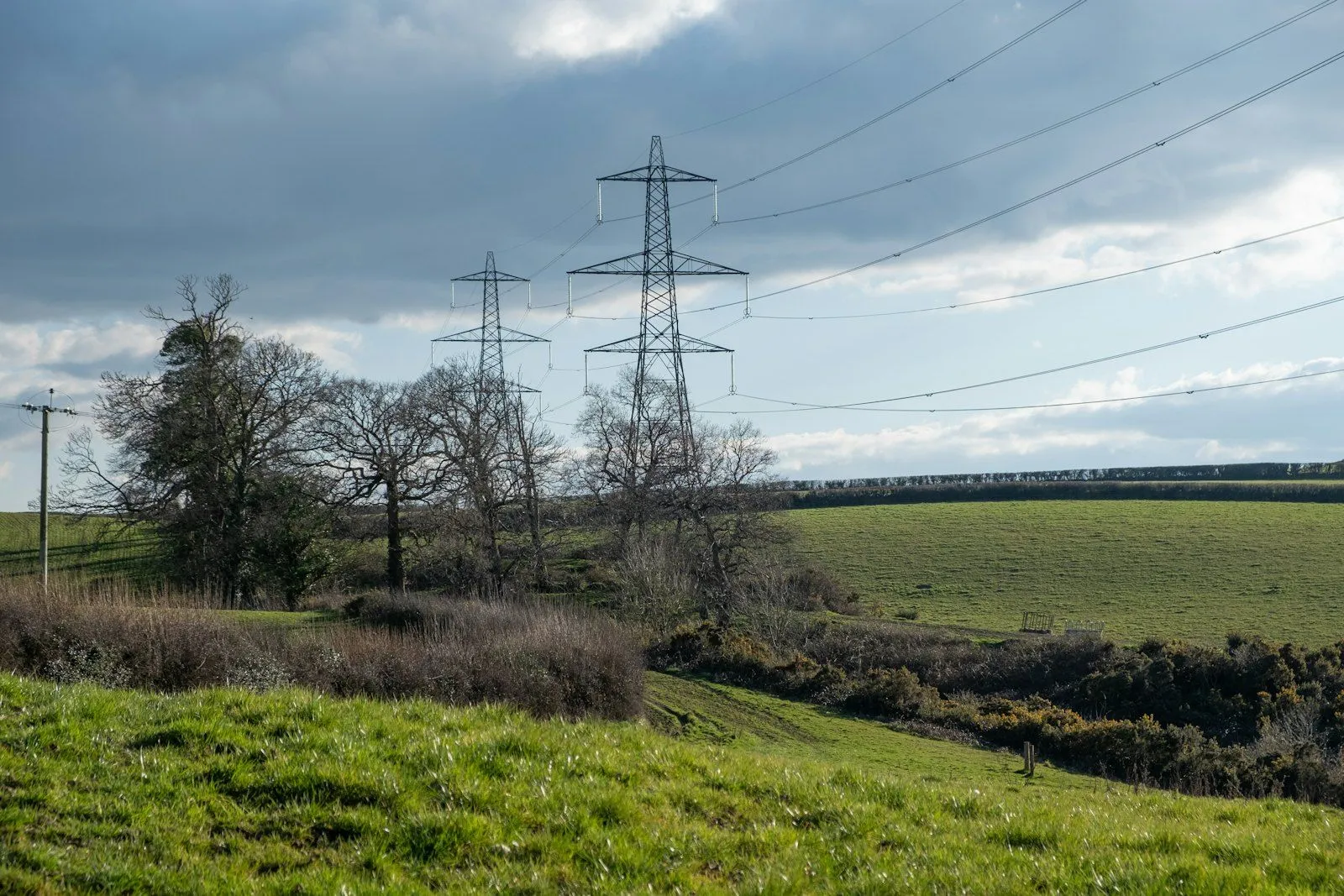
Electricity reaches your home through two networks. National Grid runs the high-voltage network of pylons that carries power across the country. Regional network operators run the local cables that bring it to your street.
Great Britain has six regional network operators: NGED, UK Power Networks, Northern Powergrid, SP Electricity North West (formerly Electricity North West), SP Energy Networks and SSEN. Northern Ireland is served by NIE Networks. When your power goes off, the fault is almost always on the local network, not the national one.
The main causes:
- Storms. These cause most long, widespread cuts. Storm Arwen in November 2021 cut power to more than a million customers. About 40,000 were off for over three days and nearly 4,000 for over a week, mostly in north-east England and Scotland; the last were reconnected after 13 days. Storm Éowyn on 24 January 2025, the UK’s most powerful windstorm in over a decade, cut power to about a million homes, mainly in Northern Ireland and Scotland.
- Equipment faults. Cables, transformers and switchgear fail, especially on older parts of the network. Overhead lines in the countryside are at risk from falling trees.
- Flooding. Flooded substations can cut power to thousands of homes at once.
- Planned work. Your network operator must give you at least two days’ notice of a planned cut.
The government’s National Risk Register rates a complete nationwide power failure as unlikely but catastrophic. Local and regional cuts are far more common.
What stops working (and what surprises people)
Everyone expects the lights and sockets to go. These catch people out.
Gas central heating stops. Around 85% of UK homes heat with gas, and the gas keeps flowing in a power cut, but the boiler doesn’t. Almost every modern boiler needs electricity for its ignition, pump, controls and fan. No electricity means no heating and no hot water.
Also likely to stop:
- Broadband and Wi-Fi. Your router needs mains power.
- Your landline, if it runs over broadband (most now do). Older analogue lines usually keep working, but these are being switched off, with a deadline of January 2027. Some providers offer battery back-up to vulnerable customers, so ask yours.
- Mobile signal, eventually. Many mobile masts have only limited battery back-up, often a few hours or less, and there’s no legal minimum. In a long, widespread cut, signal can become patchy or disappear.
- Door entry systems in flats.
- Electric car charging at home.
- Medical equipment such as oxygen concentrators, CPAP machines, stairlifts and electric wheelchairs. See the Priority Services Register below.
- Private water pumps on homes with their own borehole.
Prepare before the cut
- Test your kit. Check that the torches work, the power bank is charged and the radio picks up your local BBC station clearly.
- Find your fuse box (consumer unit). Then you can check whether a switch has tripped before assuming it’s a wider cut.
- Keep the power bank charged. Set a reminder to top it up every couple of months.
- Keep some cash at home in small notes.
- Save the numbers: 105 (England, Scotland and Wales) or 03457 643 643 (Northern Ireland).
- Join the Priority Services Register if anyone at home qualifies (see below).
- Keep your car’s fuel tank at least half full. Fuel pumps need electricity too.
When the power goes out: the first 30 minutes
- 1
Is it just you? If neighbours have lights, check your fuse box. Reset a tripped switch once; if it trips again, leave it off and call an electrician.
- 2
If it’s wider, call 105 (or 03457 643 643 in Northern Ireland), or check your network operator’s online power cut map. Report the cut and ask when it should be fixed.
- 3
Switch off and unplug appliances, especially computers and TVs, to protect them when the power returns. Leave one light switched on so you know when it’s back.
- 4
Get your kit out: torches, power bank and radio, tuned to your local BBC station.
- 5
Keep the fridge and freezer shut.
- 6
Think about warmth early. In cold weather it’s far easier to keep heat in than to get warm again later.
Food safety
With the door kept shut, a fridge stays cold for up to about 4 hours. Food that has been above 8°C for more than 4 hours, such as meat, fish, dairy and leftovers, should be thrown away.
A full freezer kept shut stays frozen for about 48 hours; a half-full one for about 24 hours.
- Don’t open the doors to check. Every opening shortens the safe time.
- Eat food from the fridge first, then the freezer.
- Never taste food to check it. Harmful bacteria often don’t change the smell or taste.
- If in doubt, throw it out.
Unsure whether thawed food can be refrozen? Follow the Food Standards Agency’s guidance, and if you can’t check, cook it and eat it straight away or throw it away.
Keeping warm
A home without heating cools faster than you’d expect on a winter night. Older people, babies and anyone with a heart or breathing condition are most at risk.
Keep the heat in:
- Close internal doors and gather everyone in one room
- Close curtains and blinds
- Block draughts under doors with a rolled-up towel
Wrap up:
- Wear layers, including a hat and warm socks, indoors
- Use sleeping bags or extra blankets at night
- Fill hot water bottles from a flask if you can heat water safely
Never use a camping stove, barbecue, patio heater or petrol or diesel generator indoors or in a garage, even with a window open. They produce carbon monoxide, a gas you can’t see or smell, which can kill. Use them outdoors only, and fit a battery-powered carbon monoxide alarm before you need it.
Keeping your phone going
Your phone may be your only way to call for help, so save its battery.
- Turn the screen brightness right down
- Turn off Wi-Fi, Bluetooth and location
- Use low-power mode, and switch to airplane mode between checks
- Charge from your power bank before the phone runs flat
- Your car can charge a phone too, but only outdoors. Never run an engine in a closed garage.
- If calls won’t connect, try a text message. Texts often get through when calls don’t.
105, compensation and the Priority Services Register
105 is the free power cut number for England, Scotland and Wales. It connects you to your local network operator, not your energy supplier. Use it to report a cut, find out when the power should return, or report damaged lines or substations. In Northern Ireland, call NIE Networks on 03457 643 643.
If you see a fallen power line, stay well away and call 105. If anyone is in danger, call 999.
Compensation: if your power is off for a long time, your network operator may have to pay you. In normal weather, households are entitled to £100 after 12 hours (24 hours if 5,000 or more homes are affected), plus £45 for each further 12 hours. Different rules apply in severe storms. Check your operator’s website for current amounts and how to claim.
The Priority Services Register is a free service for people who may need extra help during a power cut. You may be able to join if anyone in your home:
- is of pensionable age
- has a disability, long-term or serious illness, or dementia
- relies on medical equipment that needs electricity
- has sight, hearing or speech difficulties
- is a child aged five or under
- is in a temporary situation, such as recovering from a stay in hospital
Being on the register means advance notice of planned cuts, priority help and updates during a cut, and a password scheme to protect against people pretending to be engineers. It doesn’t mean extra compensation.
How to join: through your energy supplier or your network operator. They share details with each other, but it’s worth checking both have you.
If someone relies on life-critical medical equipment, also tell the equipment supplier and the person’s medical team.
Troubleshooting
The power’s back but some things aren’t working
Check the fuse box for a tripped switch and reset it. If it trips again straight away, leave it off and call an electrician.
The boiler won’t restart
Follow the manufacturer’s reset instructions. If that doesn’t work, call a Gas Safe registered engineer.
I can’t get through to 105
Try texting family to call for you, or ask a neighbour on a different mobile network. Check your network operator’s online power cut map.
Someone at home relies on medical equipment
Call 105 straight away and tell them. In an emergency, call 999.
Sources
- GOV.UK Prepare / Be Ready: Power cuts
- Powercut105 (Energy Networks Association)
- Ofgem: Power cuts (guaranteed standards and compensation)
- SSEN: Guaranteed standards of performance, April 2026
- Ofgem: Final report on the networks' response to Storm Arwen, June 2022
- Met Office: Storm Éowyn report, February 2025
- Cabinet Office: National Risk Register 2025
- Food Standards Agency: power cuts and food safety; Food Standards Scotland: power cuts
- Citizens Advice: Prepare for a power cut
- Ofgem: Priority Services Register; ScottishPower: Priority Services Register
- NIE Networks: power cut help
- ScottishPower / Iberdrola: SP Electricity North West rebrand, August 2025
- Energy UK, citing DESNZ: share of homes heated by gas
- UKHSA: carbon monoxide safety