Amateur radio is a hobby, and a skill you build before you need it. You can listen straight away. To transmit you need a licence, and getting one starts with a short course and an exam. If you want to put the skill to use for your community, RAYNET-UK is the voluntary group that does that.
Listen now, transmit later
Anyone can listen to the amateur bands. You need a licence to transmit on them, and your first licence is the Foundation licence.
If you have no radio, you have two ways to listen. The RSGB (the Radio Society of Great Britain) says you can listen on an internet receiver such as its WebSDR site, with no special equipment or aerial. Or you can go to a local amateur radio club and ask to listen in on theirs.
| What you want to do | Licence needed? | What to know |
|---|---|---|
| Listen to the amateur bands | No | You need a receiver and an aerial, which can be a long piece of wire. Or listen online, or at a club. |
| Transmit on the amateur bands | Yes, from Ofcom | Start with the Foundation licence. Applying online is free. |
| Join RAYNET | No | Open to anyone aged 14 or over, with or without a licence. Some groups set a different age. Transmitting on the amateur bands still needs a licence. |
The law behind this is short. Under section 8 of the Wireless Telegraphy Act 2006 it is unlawful to use radio transmitting equipment except under a licence from Ofcom, unless the equipment is exempt. Our guide to talking when the networks are down sets out the law for every kind of radio. In an emergency, call 999.
What amateur radio can do in a power cut
The RSGB says amateur radio does not rely on the electrical power grid or any cabled network. Mobile phones and the internet depend on fixed masts and cabling, which a disaster can disrupt, so they cannot be relied on completely. With the phone lines down and the electricity off, it is still possible to communicate with amateur radio using only battery power.
This diagram in words
A phone call needs your phone, a mast and cabling, and a disaster can disrupt the mast or the cabling. An amateur radio link needs your radio and the other person’s radio. The RSGB says it can work on battery power alone and does not rely on the electrical grid or any cabled network.
You need the licence before you transmit, so the time to start is before a power cut. To hear the news in a power cut you need no licence: see emergency broadcasting in the UK and the radio finder. For phones, see keeping your phone going.
How to get your first licence
The Foundation exam is the first step. It has 26 multiple-choice questions and you have 60 minutes to answer them. The RSGB says it usually takes about 12 hours of tuition to prepare, and likely less if you already know radio or electronics. No formal training is required, but you need to learn enough to pass.
-
Listen first
Use an online receiver or visit a club, as above. It tells you whether you want to carry on.
-
Find a course
The RSGB Course and Exam Finder lists clubs that run the Foundation course near you. Some clubs teach online and others face to face. There is also a list of online courses on the RSGB’s training pages.
-
Study
The RSGB’s Foundation Licence Manual covers what you need for the exam. The exam asks you to use fractions and decimals and to understand the licence and the training book.
-
Book and take the exam
Choose a time and date. The exam is usually taken online, at home with a remote invigilator or at a club. After an online exam you see your result straight away, with feedback.
-
Wait for your official result
The RSGB sends official results within around six working days, with a certificate showing your candidate number.
-
Apply for your licence
Register on the Ofcom licensing system, choose your call sign and apply. There is no charge for the licence if you apply online.
There is no lower age limit for taking the exam.
A worked path. Twelve hours of tuition over four weeks is three hours a week (12 ÷ 4 = 3). That is a sum, not an RSGB timetable. Your club or course sets its own schedule, and you may need fewer hours.
Your call sign comes with the licence. You use it to identify yourself when you transmit.
All radio amateurs must revalidate their licence with Ofcom at least every five years. If you do not, Ofcom may revoke it. Put the date in your diary when you get the licence.
What the licence allows
The licence lets you use the equipment for self-training in radio communications, including technical investigations, or as a leisure activity. It is not for commercial purposes of any kind, and it does not authorise business use. The RSGB describes amateur radio as using designated radio frequencies for non-commercial exchange of messages, wireless experimentation, self-training and emergency communications.
There are three licence levels: Foundation, Intermediate and Full. The RSGB’s licensing page has the details.
In an emergency
The licence has a clause for emergencies. It lets a licensee use the equipment to help with communications in a disaster or emergency, to support operations run by a user service, and in exercises for either. For that use, the rules that transmissions go only to other amateur stations and are not encrypted are lifted. The rest of the licence still applies, including the bar on transmissions for general reception, with its exceptions. The licence does not name RAYNET.
This clause is for people who hold a licence. It does not let anyone without a licence transmit.
RAYNET-UK
RAYNET is the UK’s national voluntary communications service, provided for the community by licensed radio amateurs. RAYNET-UK is a registered charity, affiliated to the RSGB. Only groups in RAYNET-UK can use the name RAYNET.
What members do
RAYNET volunteers use their own or their group’s equipment. They provide extra communications for organisations such as police and fire and rescue services, health authorities and ambulance trusts, local authority emergency planners, the British Red Cross and utility services. RAYNET calls these bodies user services. It says its volunteers can set up an emergency communications network within a few hours of a user service asking.
RAYNET says it has helped in major incidents involving flooding, evacuations, telephone exchange failures, missing-person searches and adverse weather. Between those, groups:
- practise on live exercises and table-top simulations with the emergency services and local authority emergency planning units
- provide safety communications at community events, such as marathons, triathlons and charity cycle rides
RAYNET works with the bodies it serves. In an emergency, call 999.
Joining RAYNET
Membership is open to anyone aged 14 or over with an interest in RAYNET’s aims. It does not matter whether you hold an amateur radio licence, as there are many kinds of work in RAYNET. Some groups set a different age policy, so check with the group you want to join.
To join, you register with a local group, which handles your application to RAYNET-UK. You can find your local group by sending a membership enquiry on the RAYNET-UK groups page, which passes your details to your nearest group. The joining page explains the steps.
Transmitting on the amateur bands still needs a licence, whether or not you are a RAYNET member.
What it costs
There are three separate costs, and each body publishes its own current figures:
- The exam. The RSGB sets a fee for each exam, shown on its booking and paying page. Some physical exam venues may add a small fee for room hire. The Radio Communication Foundation offers fully funded Foundation exams if you are under 21 and in full-time education.
- The course. Clubs and training organisations may or may not charge. The RSGB recommends you check thoroughly before signing up.
- The licence. Free if you apply online. Postal and other applications may incur a fee.
For RAYNET, the national membership fee is on the joining page. Local groups can set their own fee, and some pay part of the national fee for you.
Get ready now
- Listen on an online receiver or at a club.
- Search the RSGB Course and Exam Finder for a Foundation course near you.
- Keep a battery or wind-up radio at home to hear the news in a power cut, and add your radio to your household plan. You need no licence to listen.
Troubleshooting
There is no club near me
The RSGB says there are plenty of online training resources, and some clubs run courses online. You can also contact the RSGB Regional Team for support in your area.
I cannot get to an exam venue
The Foundation exam is usually taken online, at home with a remote invigilator. You choose a time and date that suits you when you book.
I do not have a radio
You do not need one to start. Listen on an online receiver, or ask a club to let you listen on theirs. You need only a receiver and an aerial, which can be a long piece of wire, to listen yourself.
I want to help but do not want a licence
RAYNET membership is open to anyone aged 14 or over, with or without a licence. You would not be able to transmit on the amateur bands.
I am under 14
The RSGB says there is no lower age limit for taking the Foundation exam. You need to be able to read and understand the licence and the training book, use fractions and decimals, and sit a formal exam. RAYNET membership starts at 14, and some groups set a different age.
Sources
- RSGB, Foundation licence
- RSGB, Becoming a radio amateur FAQ
- RSGB, Booking and paying for your exam
- RSGB, Course and Exam Finder
- RSGB, Online training resources for students
- RSGB, What is amateur radio?
- RSGB, Emergency communications
- RSGB, UK amateur licensing
- RAYNET-UK, FAQs
- RAYNET-UK, Joining RAYNET
- RAYNET-UK, RAYNET groups
- RAYNET-UK, Operations
- RAYNET-UK, home page
- legislation.gov.uk, Wireless Telegraphy Act 2006, section 8
- Ofcom, Amateur Radio Wireless Telegraphy Licence Conditions Booklet, OFW611 (21 February 2024)
- Ofcom, Amateur radio licence: guidance for licensees (updated 14 October 2025)
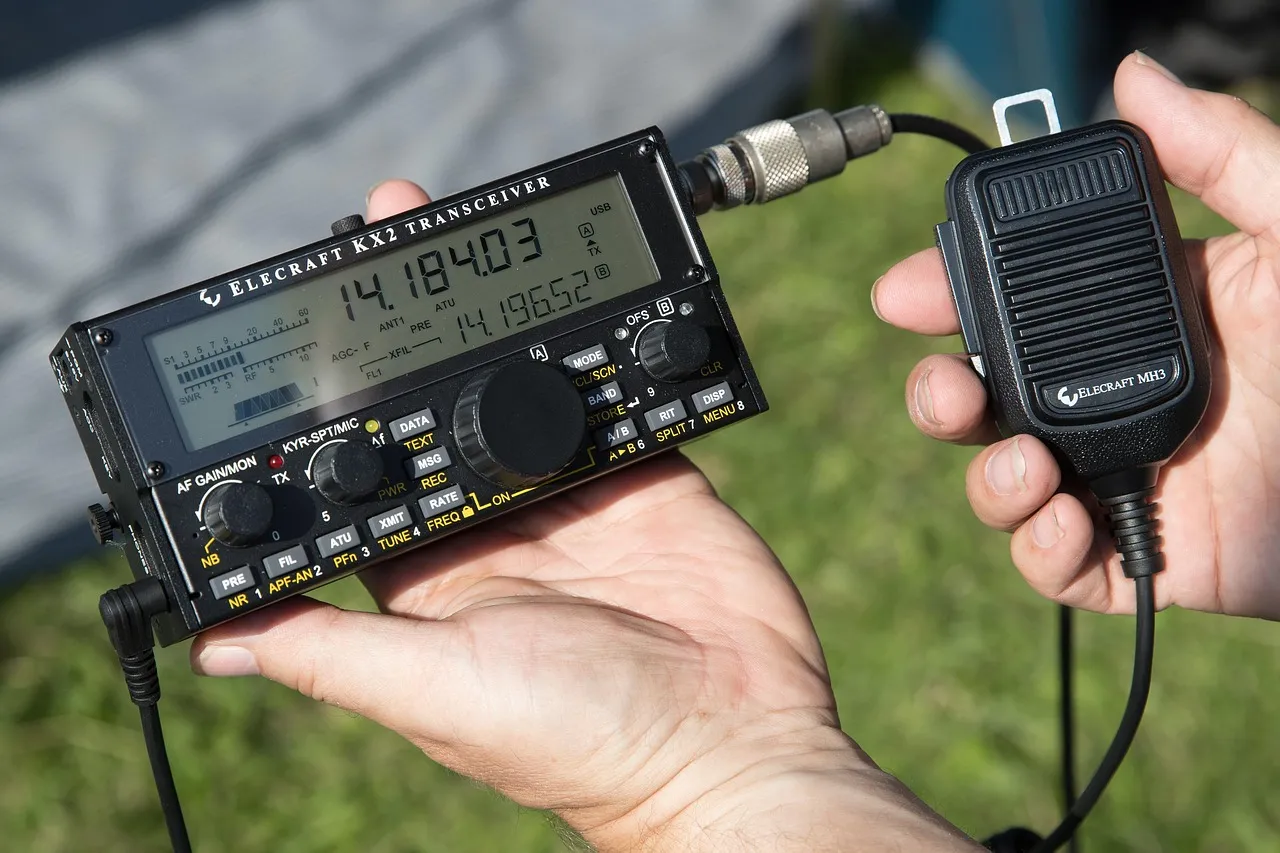
- Photo: portable amateur radio, Michael_Kastelic, Pixabay