Carbon monoxide (CO) is a gas you cannot see, taste or smell, and it can make you seriously ill. A carbon monoxide alarm is how you find out it is there. This guide tells you what to do if yours sounds, where to put alarms, what to look for when you buy one, and how to stay safe in a power cut.
If your alarm sounds
Act first, then work out the cause. Do not wait to see whether the alarm stops.
-
Stop using the appliance you think is the cause
This might be a boiler, cooker or heater. Switch it off if you can.
-
Open windows and doors
Let fresh air in if you can do it quickly.
-
Get everyone outside
Go into the fresh air. Do not go back in until you have had advice.
-
Get medical advice
Use the number for your nation in the table below. Symptoms can come and go. If you think you might have symptoms, get advice.
-
Call the gas emergency number if a gas appliance may be leaking
In England, Scotland and Wales call 0800 111 999. In Northern Ireland call 0800 002 001. 0800 111 999 is free and open 24 hours a day. 0800 002 001 is open 24 hours a day.
-
Keep the appliance off until it has been checked
A qualified professional needs to fix the source before you use it again or go back in.
Call 999 in a life-threatening emergency, for example if you or someone else has been exposed and finds it hard to breathe, becomes confused or loses consciousness. In England and Wales, do not drive to A&E. Ask someone to drive you, or call 999 and ask for an ambulance.
| Where you live | Medical advice | When to call 999 |
|---|---|---|
| England | Call NHS 111 if you think you might have symptoms | You are finding it hard to breathe, have suddenly become confused, have lost consciousness, are feeling weak or have chest or muscle pain |
| Scotland | Phone NHS 24 on 111 if you think you need A&E but it is not life or limb threatening | In a life-threatening emergency |
| Wales | Call 111 or use NHS 111 Wales online | You are finding it hard to breathe, suddenly become confused or someone loses consciousness |
| Northern Ireland | Go to your GP or nearest A&E. The GP out-of-hours service covers evenings and weekends: find the number for your area on nidirect | If it is urgent, call 999 for an ambulance |
The steps above follow NHS advice for England and Wales and guidance from the health and safety bodies.
In Northern Ireland, go to your GP or nearest A&E. If your GP surgery is closed, phone your area’s GP out-of-hours service first. You can also ring your heating engineer or the Northern Ireland Fire and Rescue Service.
Symptoms
The NHS lists these symptoms of carbon monoxide poisoning:
- a headache
- dizziness
- feeling sick or being sick
- feeling weak
- tiredness and confusion
- chest and muscle pain
- shortness of breath
- your face turning hot and red (flushing), though redness may be harder to see on brown and black skin
- loss of vision
They can feel like everyday illnesses. They may come and go. They may get worse when you spend time in an affected room or building and get better when you leave or go outside. That pattern is a clue.
The lists in Wales and Northern Ireland are a little shorter, and Northern Ireland’s adds collapse. NHS 111 Wales says you may need a check in hospital, especially if you are pregnant, a child or an older person, or have anaemia or a condition affecting your lungs, heart or blood vessels.
Why it is dangerous, and where it comes from
Carbon monoxide is colourless and has no smell, so you cannot tell if it is around you. That is why an alarm is the only warning you will get.
It is made when gas, oil, wood or coal does not burn properly. The NHS lists these sources:
- gas boilers
- gas cookers and clay ovens
- gas or paraffin heaters
- wood, gas and coal fires
- portable generators
Household appliances can produce it if they are not installed properly, are faulty or are poorly maintained. Barbecues or camping stoves used inside, and engines running in an enclosed space such as a garage, can also build it up.
Signs that a gas appliance is not burning properly, according to the HSE, include yellow or orange flames instead of blue, soot or yellow-brown staining on or around it, a pilot light that keeps going out and more condensation inside windows.
An alarm does not replace servicing. Have boilers, heaters and cookers installed properly and serviced regularly by a qualified and registered engineer, and keep chimneys and flues clean.
Smell gas? A gas leak is a separate danger. In England, Scotland and Wales, call 0800 111 999 and open all the doors and windows. In Northern Ireland, turn off the gas at the meter, open all windows and doors, do not turn any electrical equipment on or off, and call 0800 002 001.
Choosing an alarm
Buy by what the alarm is, not by name.
| Feature | What to look for |
|---|---|
| Standard | Certified to British Standard EN 50291. Gas Safe Register says to look for a Kitemark to BS EN 50291-1:2010 for homes |
| Approval mark | A British or European mark, such as a CE mark or Kitemark |
| Warning | An audible alarm that makes a loud sound |
| Battery | Government guidance for landlords in England calls a "sealed for life" battery the better option over a replaceable one |
| Life span | Alarms have a limited life. Gas Safe Register says typically 5 to 10 years; HSENI says one to six years depending on the maker. Check yours |
HSENI says an alarm must not be treated as a substitute for proper installation and maintenance of your appliances.
The NHS advice is one alarm for each room of your home that contains an appliance burning gas, oil, coal or wood. Gas Safe Register says it is advisable to fit one in every room with a gas appliance.
Where to put it
Put an alarm in each room that has a fuel-burning appliance, and follow the maker’s instructions for the exact spot.
Within a room, the distances come from UK guidance:
- England: government guidance for landlords says to put the alarm at head height, on a wall or shelf, approximately 1 to 3 metres from a possible source of carbon monoxide. Nottinghamshire Fire and Rescue Service says around 3 metres from the appliance, at door height.
- Northern Ireland: the guidance for private landlords says the alarm should be between one and three metres from the appliance. If the boiler is in a small space such as a cupboard, put the alarm outside it.
- Not at low level: HSENI says carbon monoxide is slightly lighter than air, so fitting an alarm at low level is not recommended.
The maker’s instructions come first. HSENI says to read them for the correct and safe location.
This diagram in words
A boiler is fixed to the left wall. An alarm sits at head height on the right side of the room, with a dimension line above showing about 1 to 3 metres between the boiler and the alarm. A second alarm drawn low down, near the floor, is crossed out and labelled ‘Not low down’, because carbon monoxide is slightly lighter than air.
Testing and replacing
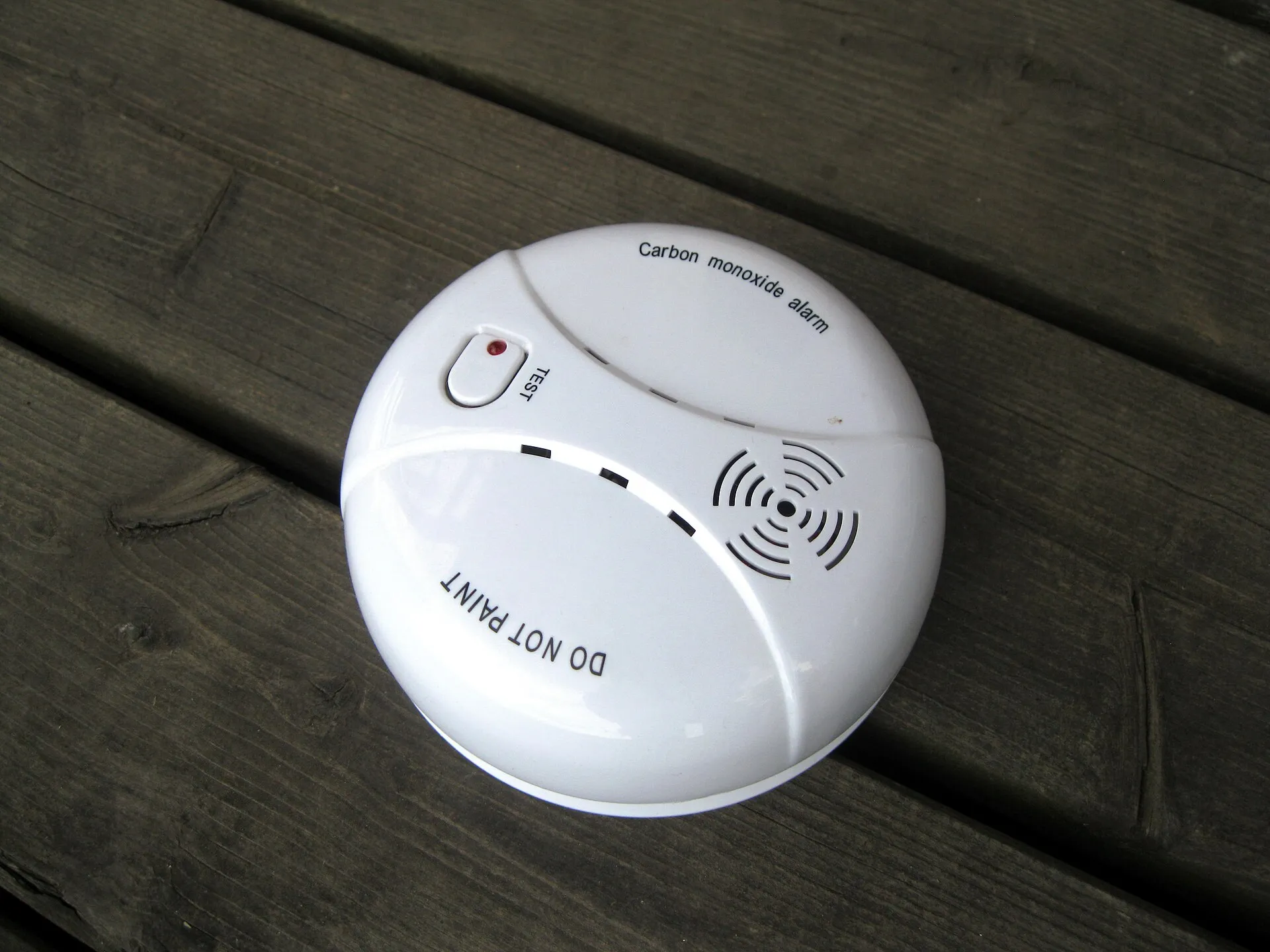
- Test it to the maker’s instructions. HSENI says to always test the alarm that way. Guidance for private landlords in Northern Ireland advises testing once a week by pressing the test button.
- Never cover or paint over an alarm. HSENI says this once it is installed.
- Check how long it lasts. Alarms have a limited life, so look at the instructions to see when yours needs replacing, and note the date in your household plan.
- Replace one that fails a test. Do not rely on it.
The law, by nation
The rules differ across the UK, and most of them cover rented homes.
| Where you live | What the rule says | Who it applies to |
|---|---|---|
| England | Under the Smoke and Carbon Monoxide Alarm regulations, since 1 October 2022 a landlord must provide an alarm in any room used as living accommodation that has a fixed combustion appliance (gas cookers excluded). Each alarm must work on the day a new tenancy begins | Private rented homes |
| Scotland | Since 1 February 2022 every home must have a carbon monoxide detector in each room with a fixed combustion appliance or a flue (appliances used only for cooking are excluded). It must be battery-powered for its working life, or hard-wired with a warning if the sensor fails, and sited 1 to 3 m from the appliance (Housing (Scotland) Act 1987, section 86; Scottish Government guidance) | All homes, owned or rented |
| Wales | Since 1 December 2022 a landlord must make sure a working alarm is in each room that has a gas, oil-fired or solid fuel appliance (Renting Homes (Fitness for Human Habitation) (Wales) Regulations 2022) | Rented homes under the Renting Homes rules |
| Northern Ireland | The Smoke, Heat and Carbon Monoxide Alarms for Private Tenancies Regulations (Northern Ireland) 2024 apply to new tenancies from 1 September 2024 and existing ones from 1 December 2024. The alarm goes in any room or circulation space with a flue or a fixed combustion appliance, other than a gas cooker or gas oven. Separately, HSENI says alarms are mandatory for new homes and where a new fossil fuel appliance is installed, after a change to the Building Regulations (Northern Ireland) 2012 that came into operation on 31 October 2012 | Private tenancies; new homes and new appliances |
If you rent and have no alarm in a room with a fuel-burning appliance, ask your landlord. If you own your home, the NHS advises an alarm in every room with a gas, oil, coal or wood appliance.
In a power cut
A power cut is when people reach for other ways to cook, heat and light. Some of them make carbon monoxide.
- Barbecues and camping stoves: never use one indoors or inside a tent. Opening tent flaps, doors or windows is not enough, and fumes can still be present many hours after you have used one. Use them outside, never indoors or in a tent.
- Generators: never use one indoors, in a garage or in a partly enclosed space, even with some ventilation. The UK Chief Medical Officers advise placing it outdoors at least 6 metres (20 feet) away, with the exhaust facing away from windows or doors. HSENI says fans will not stop carbon monoxide building up in the home.
- Gas heaters: if you use a portable gas heater that runs on gas bottles and is approved for indoor use, make sure the room is well ventilated. The Scottish Fire and Rescue Service says never to use gas cylinder heaters in high-rise flats and to always change gas cylinders in the open air.
- Open fires: do not light a fire indoors unless you have a proper heating appliance or a fireplace with a working chimney.
- Alarms: HSENI advises battery-powered carbon monoxide alarms inside your home while a generator runs. If yours is plugged into the mains or wired in, check its instructions to see whether it has a battery back-up.
A gas boiler or gas oven needs electricity to work, so you cannot count on it in a power cut. For more on staying warm, fed and safe, read extended power cuts.
Get ready now
- Count your fuel-burning appliances and check there is an alarm in each room that has one.
- Test every alarm and put the next test date in your phone.
- Look up your alarm’s life span and note when to replace it.
- Write down 0800 111 999 (0800 002 001 in Northern Ireland) and the number for your nation’s medical advice in your household plan.
- Book a regular service for boilers, cookers and heaters with a qualified and registered engineer, and put the date in your plan.
Troubleshooting
The alarm sounded and nobody feels ill
Follow the same steps. Symptoms can come and go, and the alarm exists because you cannot smell or see the gas. Leave, get advice and do not use the appliance until it has been checked.
I think I smell gas as well
Follow the gas steps in the box above and call the gas emergency number: 0800 111 999 in England, Scotland and Wales, or 0800 002 001 in Northern Ireland.
The alarm failed its test
Replace it. An alarm that does not sound when tested cannot warn you.
I rent and my landlord has not fitted an alarm
Ask your landlord, and point to the rule for your nation in the table above. In England, a landlord must check each alarm works on the day a new tenancy begins.
My boiler is in a cupboard
In Northern Ireland the guidance says to put the alarm outside the cupboard, between one and three metres from the boiler. Check the alarm maker’s instructions too.
Sources
- NHS: Carbon monoxide poisoning
- NHS 111 Wales: Carbon monoxide poisoning
- NHS 24 (Scotland)
- NHS: When to call 999
- Fire Kills (Home Office): How to choose, fit and test alarms
- HSE: Carbon monoxide awareness, frequently asked questions
- HSE: Domestic gas, frequently asked questions
- HSENI: Carbon monoxide
- HSENI: Carbon monoxide alarms
- HSENI: Carbon monoxide dangers from heating appliances and generators used indoors
- HSENI: Safety tips, using a portable generator in an emergency
- nidirect: Gas safety and carbon monoxide
- nidirect: Energy, power supply and utilities
- nidirect: GP out of hours service
- nidirect: Health and safety in rented accommodation
- GOV.UK: Smoke and carbon monoxide alarm regulations, explanatory booklet for landlords
- Department for Communities (Northern Ireland): Smoke, Heat and Carbon Monoxide Alarms for Private Tenancies Regulations (Northern Ireland) 2024, guidance notes
- Housing (Scotland) Act 1987, section 86 (the tolerable standard)
- The Housing (Scotland) Act 1987 (Tolerable Standard) (Extension of Criteria) Amendment Order 2021
- The Renting Homes (Fitness for Human Habitation) (Wales) Regulations 2022, regulation 5
- Gas Safe Register: Carbon monoxide alarms
- Scottish Government: Tolerable standard guidance, satisfactory fire and carbon monoxide detection
- London Fire Brigade: Carbon monoxide safety
- Nottinghamshire Fire and Rescue Service: Carbon monoxide
- Northamptonshire Fire and Rescue Service: Barbecues
- Cheshire Fire and Rescue Service: Camping safety
- Scottish Fire and Rescue Service: Power cuts
- GOV.UK: Public health advice from UK Chief Medical Officers during a national power outage, keeping warm or cool
- Be Ready: Power cuts
- Photo: carbon monoxide alarm, Santeri Viinamäki, Wikimedia Commons, CC BY-SA 4.0