Your fuse box, also called a consumer unit, is the box that holds the main switch and the fuses or circuit breakers that protect each circuit in your home. Most of the time you never touch it. When a switch trips, or the lights go out, knowing your way round it helps you get the power back on, and tells you when to stop and call an electrician.
If the power goes off in your home
First find out whether the problem is in your home or on the network.
- Check your neighbours. If they have no power either, the fault is likely on the network. Call 105 for free in England, Scotland and Wales. In Northern Ireland, call NIE Networks on 03457 643 643. Don’t assume someone else has already reported it.
- If your neighbours have power and you don’t, the problem is likely in your fuse box. Go to it with a torch and look for a switch in the off position.
- Check your meter. If it has a display, power is coming into your home.
If you can’t see which switch has gone off, the network operator SSEN suggests a full reset: turn off the main switch, then all the smaller switches. Then turn the main switch back on, and the smaller switches on one by one. If that doesn’t bring the power back, call 105 (03457 643 643 in Northern Ireland).
When a switch has tripped
A switch that has tripped has dropped down. A trip is most likely to be caused by a faulty appliance, not the wiring. A light bulb that has just blown can do it too.
-
Find the switch that is down
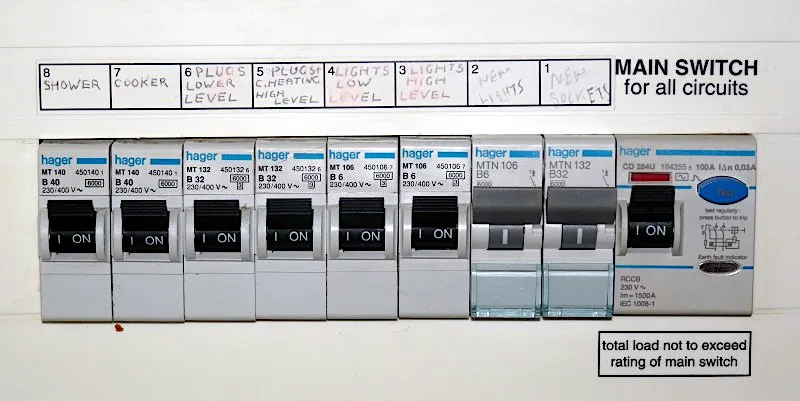
It will be one of the narrow circuit breakers, or one of the wider RCDs, which switch off several circuits at once.
-
Unplug everything on that circuit
Take each plug right out of the socket. Switching off at the socket is not enough.
-
Push the switch back up
Only once you have unplugged things. A breaker is meant to be reset once the fault is dealt with.
-
Plug things back in one at a time
If the switch trips again as you plug something in, that is the faulty appliance. Leave it unplugged and contact the manufacturer or a qualified repair technician.
-
If it won't stay up, stop
If the switch trips with everything unplugged, or keeps tripping, call a registered electrician. Resetting a switch again and again on a fault can damage it.
Faults in the wiring itself are less common, but more likely after DIY, such as a nail put through a cable while hanging a picture or a shelf. Water in the electrics is another cause.
Switch off at the main switch and call a registered electrician if you smell burning, see smoke or scorch marks, or the fuse box feels hot. If someone is getting an electric shock, turn the power off at the main switch.
What is inside your fuse box
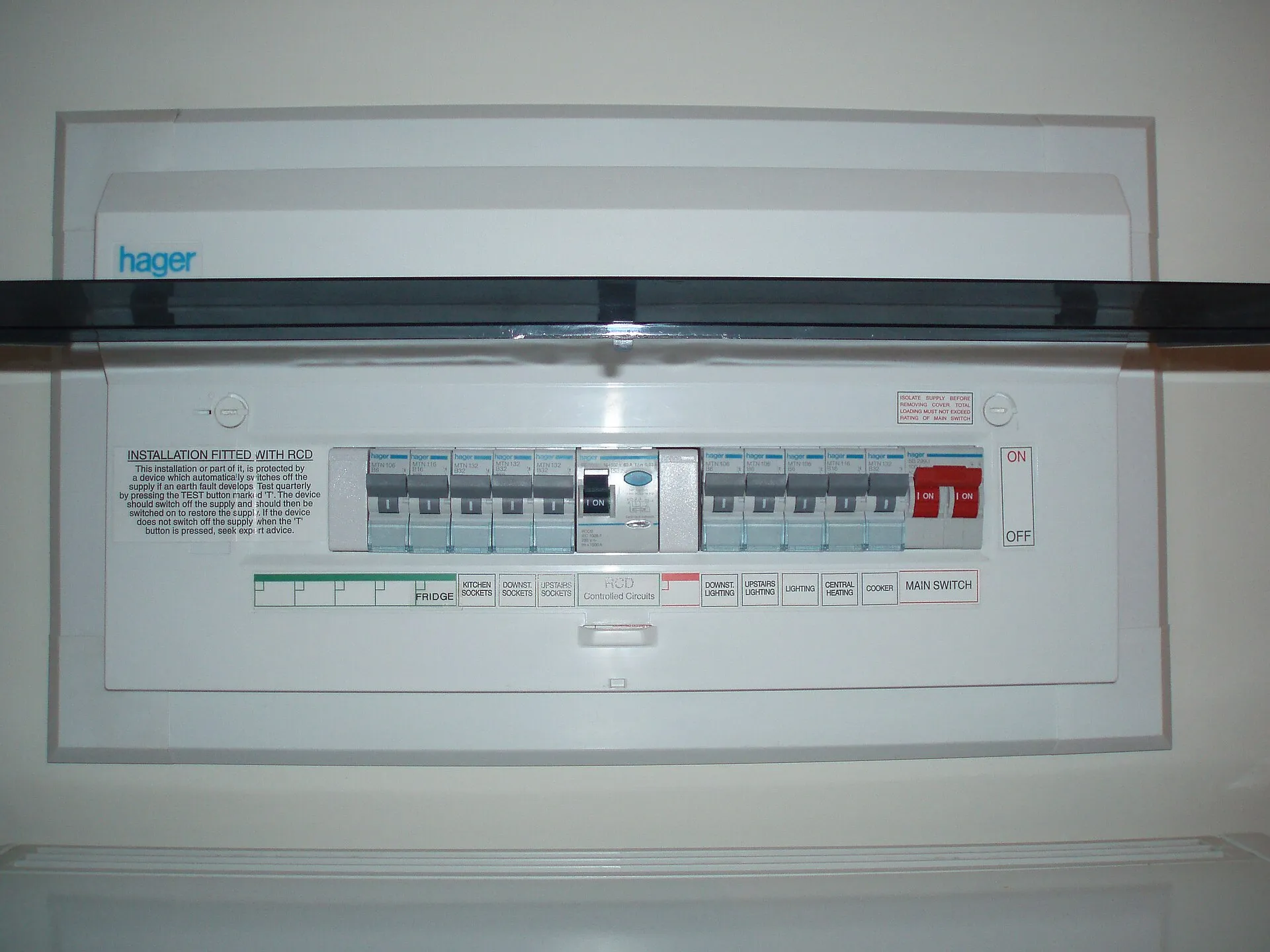
A fuse box holds three kinds of switch: a main switch, a circuit breaker (or fuse) for each circuit, and one or more RCDs. The usual layout has two RCDs, each looking after a group of circuits.
This diagram in words
From left to right: the main switch, which turns off everything; the first RCD, with its test button marked T, and the three circuit breakers it protects; then the second RCD, with its own test button, and its three circuit breakers. Every lever points up, which means on, except the last circuit breaker. It has tripped, so its lever points down.
| Switch | What it protects against | What it covers | If it trips |
|---|---|---|---|
| Main switch | Nothing on its own: it turns the supply off | The whole home | It is for isolating, not protection: use it to switch everything off in an emergency |
| Circuit breaker | Too much current and short circuits | One circuit, such as the sockets or the lights | Unplug, reset, then find the faulty appliance |
| RCD | Electricity leaking out of the circuit, such as through a person | A group of circuits | The same. Test it as the label on your unit says |
| RCBO | Both: too much current and leaks | The circuit it is fitted to | The same as a circuit breaker |
| Rewirable fuse | Too much current and short circuits | One circuit | If fuses blow often, get a registered electrician to check |
Circuit breakers and fuses
Each circuit in your home, such as the cooker, the shower, the sockets and the lights, has its own circuit breaker. It switches the circuit off if too much current flows, for example through a short circuit. Each one is rated in amps (A). Older fuse boxes do the same job with rewirable fuses.
RCDs
An RCD watches the current flowing through the circuits it protects. If some electricity takes a path it shouldn’t, such as through a person who has touched a live part, it switches off very quickly. That greatly reduces the risk of death or serious injury. RCDs are rated in milliamps (mA), so they are thousands of times more sensitive than a circuit breaker or fuse. An RCBO is a circuit breaker and an RCD in one device.
The main switch
The main switch turns off the supply to the whole home. It gives no protection by itself, but it is how you switch everything off in an emergency. Some homes have more than one main switch, so check how many you have.
Newer fuse boxes
New consumer units may also have surge protection, which guards against sudden spikes in voltage, most often from lightning, and some have arc fault detection, which the wiring regulations recommend to protect against fire. Since January 2016, the wiring regulations have required consumer units in homes to be made of non-combustible material, so that a fire inside the box stays inside it.
Test your RCD regularly
Your RCD has a test button marked T or Test. Pressing it checks that the RCD switches off as it should.
-
Press the test button
The RCD’s switch should drop down, and the circuits it protects go off. The test only works while the power is on.
-
Push the switch back up
The circuits come back on. -
If it didn't switch off, get it checked
If the switch does not drop when you press T, ask a registered electrician to look at it.
Follow the label on your fuse box. Older labels say every three months. Since the 2018 wiring regulations, the advice is every six months: an easy way to remember is to do it when the clocks change. Electrical Safety First still says every three months.
In an older study for the Electrical Safety Council (now Electrical Safety First), 607 RCDs in housing association and council homes were tested and over 96% worked. But most of the people living there said they had never pressed the button.
If you can’t find a T button, your fuse box may not have an RCD. Until you get it checked, Electrical Safety First suggests plug-in RCDs for the sockets in your home.
Is your fuse box an old one?
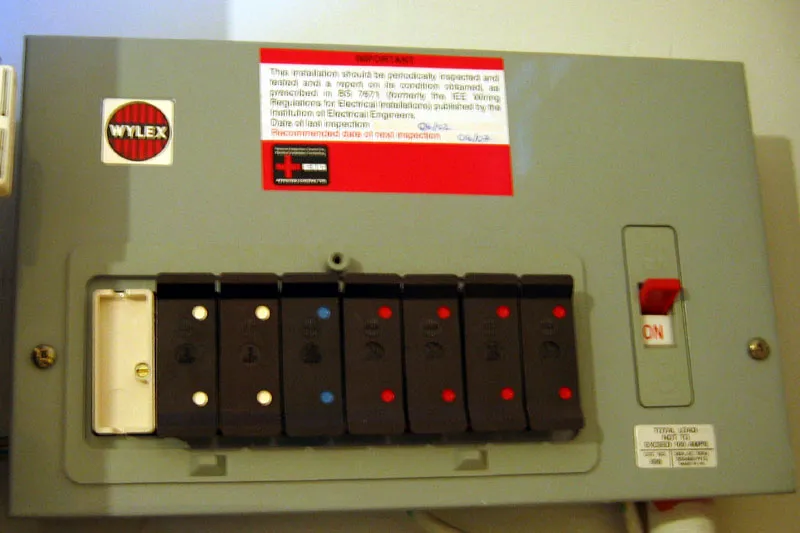
A fuse box should have a main switch and fuses or circuit breakers. Electrical Safety First says it should not have:
- a wooden back
- cast iron switches
- what looks like a mix of different makes of switch
An older fuse box without an RCD or circuit breakers is not necessarily unsafe, and does not always need replacing. An electrical inspection will tell you. If the electrics in your home are more than 50 years old, have them checked and updated. And if circuit breakers trip or fuses blow often, get them checked by a registered electrician.
Getting your electrics checked
An electrician inspects and tests your electrics and gives you an Electrical Installation Condition Report (EICR). Anything that needs work is given a code:
- C1: danger present. It needs putting right straight away.
- C2: potentially dangerous. It needs putting right urgently.
- C3: improvement recommended.
- FI: further investigation needed.
| Your home | How often | Who arranges it |
|---|---|---|
| You own it (anywhere in the UK) | At least every 10 years, as Electrical Safety First and the IET recommend | You |
| Private rented, England | At least every 5 years, by law | Your landlord |
| Private rented, Scotland | At least every 5 years, by law | Your landlord |
| Private rented, Wales | At least every 5 years, by law | Your landlord |
| Private rented, Northern Ireland | At least every 5 years, by law | Your landlord |
Your fuse box may have a label showing when it was last inspected.
Who can work on your electrics
Use a registered electrician for any installation or repair work. They work to the wiring regulations (BS 7671) and are insured. You can find one on Electrical Safety First’s website. For bigger jobs, get at least three quotes.
The rules differ across the UK:
- England and Wales: electrical installation work in a home must meet Part P of the Building Regulations. Either use an electrician registered with a government-approved scheme, who gives you a certificate, or tell your council’s building control before the work starts.
- Scotland: the building standards system applies. Work done under a building warrant is approved by a registered installer (an approved certifier) or checked by the council.
- Northern Ireland: Electrical Safety First strongly recommends a competent registered electrician for any electrical work.
The main fuse (the cut-out) and the cable into your home are your network operator’s responsibility, and the meter is your electricity supplier’s. Leave work on them to the network operator or the supplier. Keep clothes, paper and cleaning things away from the main fuse, the meter and the fuse box.
Get ready now
- Find your fuse box and any other main switches, so you can switch off in an emergency. It is usually near the electricity meter.
- Keep a torch with fresh batteries where you can reach it easily.
- Check for a T button, and put the next test date in your phone.
- Write down 105 (or 03457 643 643 in Northern Ireland) and note where your fuse box is in your household plan.
Troubleshooting
The switch trips again as soon as I push it up
Unplug everything on that circuit and try again. If it still trips with nothing plugged in, the fault may be in the wiring. Stop and call a registered electrician.
The lights went off when a bulb blew
A failed bulb can trip the lighting circuit. Replace the bulb, then push the breaker back up.
Nothing is switched off, but I have no power
Check whether your neighbours have power and whether your meter has a display. If your neighbours are off too, call 105 (03457 643 643 in Northern Ireland). If not, try the full reset described above, then call 105 if the power is still off.
The RCD trips after heavy rain or a leak
Water in the electrics can trip an RCD. Don’t reset it while water may still be in the electrics: call a registered electrician.
Sources
- Electrical Safety First: Electricity made easy
- Electrical Safety First: Your questions answered
- Electrical Safety First: Advice for older and vulnerable people
- Electrical Safety First: Advice for home buyers
- Electrical Safety First: Fire prevention tips
- Electrical Safety First: First aid
- Electrical Safety Council (now Electrical Safety First): RCDs put to the test
- Electrical Safety First: Part P of the building regulations
- Electrical Safety First: Building regulations for electrical installations
- Electrical Safety First: Find a registered electrician
- IET: Consumer units (consumer guidance)
- IET: Consumer units and protective devices FAQs (BS 7671:2018)
- IET Wiring Matters: Removing the distributor's cut-out fuse, July 2025
- SSEN: What to do during a power cut
- Met Office: What to do in a power cut
- Be Ready: Power cuts
- Utility Regulator (Northern Ireland): Supplier contact information
- GOV.UK: Electrical safety, Approved Document P
- The Electrical Safety Standards in the Private Rented Sector (England) Regulations 2020
- GOV.UK: Electrical safety standards in the private rented sector, guidance
- Scottish Government: Repairing standard, statutory guidance for private landlords, section D
- Welsh Government: Renting homes, frequently asked questions for landlords
- The Renting Homes (Fitness for Human Habitation) (Wales) Regulations 2022, regulation 6
- Department for Communities: Electrical Safety Standards for Private Tenancies Regulations (Northern Ireland) 2024
- nidirect: Health and safety in rented accommodation
- Ashfield District Council: A tenant’s guide to consumer units (PDF)
- Aberdeenshire Council: Electricity safety
- Photo: older fuse box with rewirable fuses, Secretlondon, Wikimedia Commons, CC BY-SA 3.0
- Photo: consumer unit with labelled circuits, Wikimedia Commons, CC BY-SA 3.0
- Photo: labelled circuit breakers, Pfnicholls, Wikimedia Commons, CC BY-SA 4.0